Sleep & Cortisol: How They Control Your Anxiety Baseline
Your anxiety level isn't just about your thoughts. It's about your cortisol rhythms, your sleep depth, and whether your nervous system ever gets to fully downshift.
· 8 min read
Key Takeaway
Most people treat anxiety like a thought problem. Something happens, a worry shows up, and you try to think your way out of it. Sometimes that works. But if you've ever noticed that on certain days everything feels harder — more irritating, more threatening, more exhausting — without any obvious trigger, the explanation is probably not psychological. It's physiological.
Your baseline anxiety level is largely a product of two things: how well your cortisol rhythm is functioning and how restorative your sleep actually is. These aren't separate variables. They're a loop. And once that loop tips the wrong direction, it tends to stay there.
What Cortisol Actually Does (It's Not Just a Stress Hormone)
Cortisol gets framed as the villain in most wellness content, but that's too simple. You need cortisol. It's what wakes you up in the morning, helps you respond to physical and psychological demands, and regulates inflammation. The problem isn't cortisol — it's dysregulated cortisol.
In a healthy system, cortisol peaks sharply in the 30–45 minutes after waking, then gradually declines through the day, reaching its lowest point around midnight. That curve is your body's built-in arousal schedule. When it's intact, you feel alert in the morning and wind down naturally in the evening.
When that rhythm gets disrupted — through poor sleep, chronic stress, irregular schedules, or all three — the curve flattens or shifts. You might wake up with low cortisol and feel groggy for hours, then have a cortisol spike at 10pm that makes your brain feel inexplicably wired. Sound familiar?
How Poor Sleep Raises Your Stress Floor
Here's the part most people don't realize: sleep deprivation doesn't just make you tired. It actively raises your physiological stress load, even before anything stressful happens.
One well-designed experimental study found that sleep-restricted participants had higher resting cortisol and a larger cortisol spike in response to a social stressor, compared to when they were fully rested. The same people became more stress-reactive after losing sleep — not because their life got harder, but because their HPA axis got more sensitive.
This is the mechanism behind why you snap at small things when you're sleep-deprived, or why manageable problems feel catastrophic after a few bad nights. It's not weakness. It's neurobiology.
The HPA Axis and Why It Matters
The HPA axis — hypothalamic-pituitary-adrenal — is the body's main stress-response system. When it perceives a threat (physical, psychological, or metabolic), it signals the adrenal glands to release cortisol. In a healthy system, this response is proportionate and short-lived. The threat passes, cortisol drops, you return to baseline.
In a chronically sleep-deprived or chronically stressed system, the HPA axis doesn't fully downregulate. It stays in a slightly elevated state — not full-blown fight-or-flight, but not calm either. Think of it like a car engine that never quite idles. Everything downstream is slightly more activated: heart rate variability goes down, inflammatory markers creep up, and the threshold for triggering an anxiety response gets lower.
Insomnia, Cortisol, and the Hyperarousal Model
People with chronic insomnia don't just sleep poorly. They tend to run hotter physiologically — higher core body temperature at night, faster resting heart rate, and elevated cortisol across the 24-hour cycle. This is what researchers call the hyperarousal model of insomnia: the nervous system is stuck in a higher gear, which makes sleep onset harder, sleep depth shallower, and waking more frequent.
A 2022 meta-analysis confirmed moderately elevated cortisol levels in people with chronic insomnia, consistent with this hyperarousal framework. And a more recent clinical study found that insomnia severity correlated with higher morning cortisol, higher depression scores, and higher tension-anxiety scores — not independently, but as part of the same cluster.
Deep Sleep Is Your Nervous System's Reset Button
Not all sleep is equal, and this matters more than total hours. The most restorative phase — N3, or slow-wave sleep — is where your brain consolidates memory, clears metabolic waste, and physically downregulates the HPA axis. Miss out on N3 and you wake up having technically slept but not actually recovered.
The same 2023 study that linked insomnia severity with cortisol and anxiety also found that more N3 sleep correlated with lower tension-anxiety scores, while lighter, more fragmented sleep predicted greater fatigue and more anxious affect the next day. Quality is the variable, not just quantity. More slow-wave sleep was associated with meaningfully lower anxiety symptoms — not by a little.
This makes sense mechanistically. During N3, cortisol hits its daily nadir. Growth hormone peaks. The parasympathetic nervous system dominates. Inflammatory cytokines that accumulated through the day get cleared. It's not a passive off-state — it's active restoration. When you fragment this phase through alcohol, late screens, irregular schedules, or high pre-sleep arousal, you skip the recovery your nervous system actually needs.
The Two-Way Loop (And Why It Sticks)
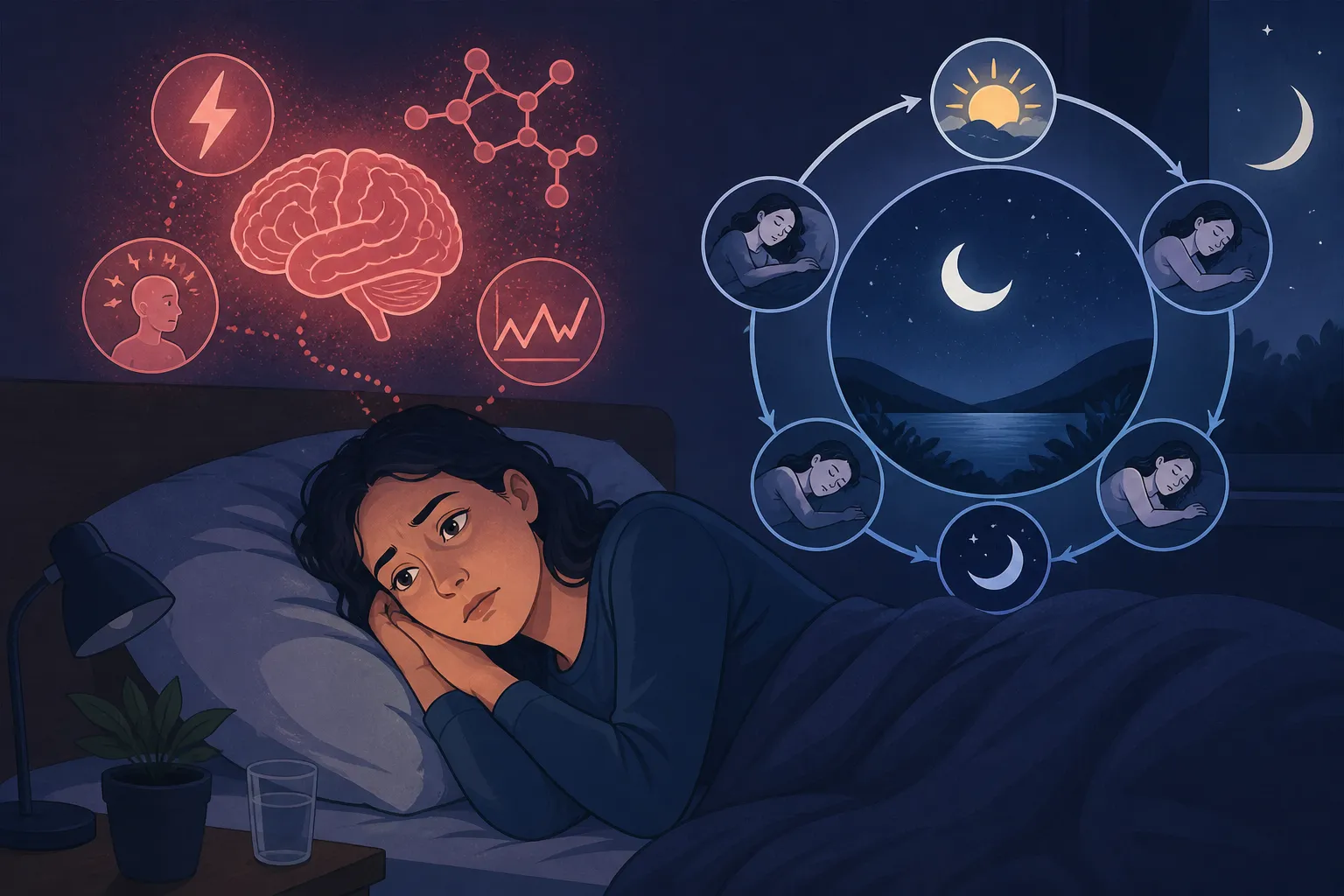
The reason this pattern is so hard to break is that it runs in both directions simultaneously. Poor sleep raises your cortisol baseline. Elevated cortisol and HPA activation make it harder to fall asleep, harder to stay asleep, and harder to reach deep sleep. Which means tomorrow night's sleep will also be poor. Which raises your cortisol further.
- Night 1: Stress keeps you wired, you sleep lightly, wake at 3am
- Morning 2: Higher baseline cortisol, lower stress threshold, more irritable
- Day 2: Everything feels slightly more threatening, harder to regulate emotionally
- Night 2: More pre-sleep anxiety, harder to wind down — and repeat
Inflammation adds another layer. Cytokines like IL-1β and TNF-α — which increase under chronic stress — directly interfere with sleep architecture. So stress doesn't just make your mind busy at night. It changes the chemistry of sleep itself.
If you've also noticed your gut acting up during stressful periods, that's not a coincidence. The gut-brain axis runs through many of the same signaling pathways. The gut-sleep connection is bidirectional in the same way: poor sleep alters the microbiome, and a disrupted microbiome can amplify stress reactivity and make sleep worse.
What to Actually Do About It
If the loop is bidirectional, the entry point doesn't matter as much as consistency. You can start from the sleep side or the cortisol side — both create downstream improvements in the other.
On the Sleep Side
- Protect your sleep window. Same bed and wake time, including weekends. Your cortisol rhythm is anchored by the clock, and irregular timing is one of the fastest ways to flatten the morning cortisol peak and blunt daytime energy.
- Reduce pre-sleep arousal, not just screens. The reason screens matter is light plus cognitive stimulation. But a stressful conversation, a work email, or anything that activates your threat-detection system within 60–90 minutes of bed has the same effect.
- Watch alcohol and late eating. Both suppress N3 sleep even when they don't seem to disturb sleep onset. You might fall asleep fine and still wake up unrested.
On the Cortisol Side
- Morning light exposure. Natural light in the first 30–60 minutes after waking sharpens the cortisol awakening response — the sharp early-morning peak. A sharper, well-timed peak means a cleaner drop by evening, which supports better sleep onset.
- Anchor your nervous system with movement. Morning exercise (even 20 minutes of walking) drives a healthy cortisol pulse and helps recalibrate HPA axis sensitivity over time. The goal isn't to exhaust yourself — it's to give the system a clear, controllable stress-and-recovery cycle.
- Recognize what you can't shortcut. If you're running a sleep debt, your cortisol reactivity will stay elevated regardless of how many adaptogens you take. The physiology requires actual sleep hours. You can support the system, but you can't fully substitute for it.
It's also worth zooming out. The same patterns that drive poor sleep and elevated cortisol — sedentary habits, irregular schedules, chronic low-grade inflammation — are the same ones covered in the broader picture of how physical health shapes mental state. The systems aren't separate.
And if what you're dealing with is more acute — the racing mind, the intrusive thoughts, the sudden spike of dread — grounding techniques like the 5-4-3-2-1 method can interrupt the acute cycle while you work on the longer structural issues.
What to Take From This
Your baseline anxiety is not fixed and it is not purely psychological. It's a physiological state, shaped in large part by your cortisol rhythm and the depth of your sleep. When the loop tips toward poor sleep and elevated stress hormones, everything feels harder — not because you're broken, but because your nervous system is running in a higher gear than it should be.
The most direct thing you can do tonight: pick one thing that reduces pre-sleep arousal and do it consistently for two weeks. Not a supplement, not a complex protocol — just close the gap between your last stimulus and your sleep window. That single change, done consistently, tends to shift N3 sleep quality more than almost anything else. And better N3 is where the cortisol reset actually happens.
Science Note
Try This
FAQ
Does cortisol cause anxiety, or does anxiety cause high cortisol?
Both. The relationship is bidirectional. Elevated cortisol — from poor sleep, chronic stress, or HPA axis dysregulation — lowers your threshold for triggering anxious responses. And chronic anxiety keeps the HPA axis in a slightly activated state, which sustains elevated cortisol. This is why anxiety often feels self-perpetuating rather than tied to specific triggers. Addressing the physiology (sleep, rhythm, arousal load) is often more effective than trying to manage the thoughts in isolation.
How much does sleep deprivation actually raise cortisol?
Experimental data shows that even partial sleep restriction raises resting cortisol and amplifies the cortisol spike in response to a social stressor. The increase isn't always dramatic in absolute numbers, but what matters functionally is the shift in reactivity — your stress system becomes more sensitive, which means smaller triggers produce bigger responses. In people with chronic insomnia, meta-analytic data shows moderately elevated cortisol sustained across the full 24-hour cycle, not just at night.
Why do I wake up at 3am with anxiety even when I fall asleep fine?
Sleep in the second half of the night is lighter by design — you cycle toward more REM and less N3. If your cortisol is even slightly elevated, that natural lightening of sleep is enough to push you into waking. Cortisol also has a secondary, smaller rise in the early morning hours. If that rise comes too early — due to HPA dysregulation or high-stress load — it can wake you before your intended alarm. Addressing cortisol rhythm through consistent wake times and morning light exposure tends to help more than sleep aids in this specific pattern.
Is sleep quality more important than sleep quantity for anxiety?
For nervous system regulation, depth appears to matter significantly. Research specifically links more N3 slow-wave sleep with lower tension-anxiety scores, independent of total sleep time. That said, the two aren't fully separable — fragmented sleep tends to reduce both quantity and quality. The more useful framing is: are you consistently getting enough uninterrupted sleep, in a consistent window, without substances that suppress N3? If yes, quality and quantity usually take care of themselves together.
Can supplements fix high cortisol if my sleep is bad?
Supplements like ashwagandha, phosphatidylserine, and magnesium have modest evidence for blunting cortisol or supporting sleep onset. But they work at the margins. If your sleep is chronically poor — fragmented, short, or mistimed — the physiological stress load is too large for supplements to meaningfully offset. Think of them as supporting a good system, not rescuing a broken one. The structural changes (consistent sleep window, pre-sleep arousal management, morning light) are what actually recalibrate the HPA axis over time.
How long does it take to reset cortisol rhythm after a period of poor sleep?
There's no clean clinical answer, but anecdotally and mechanistically, most people notice meaningful changes in 2–3 weeks of consistent sleep timing and morning light exposure. The cortisol awakening response — the sharp morning peak — is one of the more trainable aspects of the system. HPA axis sensitivity takes longer to recalibrate if you're recovering from months of chronic stress or insomnia. Progress is usually felt before it's fully complete, so tracking your morning energy and emotional reactivity is a better real-time signal than any biomarker.
Does the gut affect cortisol and sleep?
Yes — through the gut-brain axis. The gut microbiome influences HPA axis tone, serotonin availability, and vagal nerve signaling, all of which affect both stress reactivity and sleep quality. Dysbiosis (imbalanced gut bacteria) has been associated with increased HPA reactivity and disrupted sleep architecture. This is why chronic stress tends to cause digestive symptoms, and why poor gut health can make anxiety and sleep problems worse. It's the same loop, just with an additional node.
Biohacking without the $10K budget
Get practical weekly insights on sleep, gut health, and mindset, built for real life in Southeast Asia and beyond.
Subscribe freeRelated Articles
CBT-I Beginner's Guide: Better Sleep Without a Therapist
CBT-I is the most effective long-term treatment for insomnia — and you don't need a therapist to do it. Here's how to run the program yourself.
Gut Health and Sleep: The Bidirectional Connection
Poor sleep wrecks your gut. A disrupted gut wrecks your sleep. Here's how the loop works — and how to start breaking it.
The 5-4-3-2-1 Grounding Technique for Anxiety Relief
When anxiety spikes, your brain doesn't need motivation — it needs a circuit breaker. The 5-4-3-2-1 grounding technique is exactly that.