CBT-I Beginner's Guide: Better Sleep Without a Therapist
CBT-I is the most effective long-term treatment for insomnia — and you don't need a therapist to do it. Here's how to run the program yourself.
· 8 min read
Key Takeaway
Why CBT-I — and Why Not Just Take a Pill
Most people who can't sleep reach for melatonin, a Benadryl, or eventually a prescription. That's understandable. But sleep medications work by sedating you — they don't fix the underlying reason your brain won't shut off. When you stop taking them, the insomnia is usually right where you left it.
CBT-I takes a different approach. It targets the thoughts and behaviors that maintain insomnia — the anxious pre-bed checking, the lying awake doing mental math about how many hours you have left, the conditioning that's slowly turned your bed into a place your nervous system associates with frustration. Fix those, and sleep tends to follow.
The evidence is unusually strong for something in the mental health space. Research consistently shows that CBT-I outperforms medication on long-term outcomes, with lower relapse rates and effects that compound over time rather than fade.
Does Self-Guided CBT-I Actually Work?
The most common objection: I can't afford a CBT-I therapist. Certified CBT-I therapists are scarce and expensive, and waitlists are long. The good news is that the self-help version holds up surprisingly well on its own.
Studies consistently put improvement rates for self-directed CBT-I at 70–80% across sleep onset time, total sleep duration, and overall sleep efficiency. A large-scale review of 145 studies confirmed that self-help formats retain the core therapeutic components — sleep restriction, stimulus control, cognitive restructuring — and produce clinically meaningful outcomes.
One randomized controlled trial found that a self-guided internet-based CBT-I program was not just effective but actually outperformed an active control condition at the six-month follow-up. That's not a small result.
The catch: self-guided CBT-I requires more self-discipline than swallowing a pill. You have to track your sleep, follow protocols that feel counterintuitive at first, and sit with some short-term discomfort. That's the price of a durable fix.
The Five Core Components
CBT-I isn't one thing — it's a structured set of techniques that work together. Here's what each one does and why it matters.
Sleep Restriction
This is the most powerful tool in the CBT-I kit, and the one most people resist. The idea: you temporarily compress the window of time you're allowed to be in bed — often to five or six hours — regardless of how tired you are. No naps. No lying in bed awake.
It sounds brutal. The logic is airtight. By limiting bed time, you build up genuine sleep pressure (adenosine accumulation) so that when you do get into bed, your brain actually wants to sleep. Over one to two weeks, you gradually expand the window as your sleep efficiency improves.
This is why CBT-I has a rough early phase — you will feel more tired before you feel better. That's not a side effect. That's the mechanism working.
Stimulus Control
If you lie awake in bed regularly, your brain starts associating the bed with wakefulness and frustration rather than sleep. Stimulus control breaks that association. The rules are simple and non-negotiable during the program:
- Use the bed only for sleep and sex. No reading, no scrolling, no watching shows.
- If you can't sleep after roughly 20 minutes, get up. Go somewhere dim and quiet. Return only when you feel sleepy.
- Wake up at the same time every day — including weekends. This is load-bearing.
It feels weird to leave your bed when you're exhausted. Do it anyway. You're reconditioning the association, and that takes repetition.
Cognitive Restructuring
Insomnia generates a specific kind of catastrophic thinking: I'll never sleep properly again. I'll be useless tomorrow. My health is ruined. These thoughts are distressing — and they spike arousal right when you need to wind down.
Cognitive restructuring doesn't ask you to think positively. It asks you to think accurately. Most predictions insomniacs make about the consequences of poor sleep are exaggerated. One bad night doesn't break your cognitive function. Your body will compensate. Catching these distortions in writing, examining the evidence, and replacing them with realistic interpretations is a learnable skill.
Relaxation Training
CBT-I includes structured relaxation not as a sleep hack but as a way to reduce physiological arousal — the elevated heart rate and muscle tension that keep the nervous system primed when it should be downshifting. Progressive muscle relaxation (PMR) and diaphragmatic breathing are the standard tools here.
These work best practiced daily, not just on bad nights. If you only try PMR when you're desperate at 2am, it won't have the same effect as a body that's already trained to downregulate on cue.
Sleep Hygiene and Psychoeducation
Sleep hygiene gets a bad reputation because it's usually offered as a complete solution when it's actually the foundation. Keeping a consistent wake time, managing light exposure, and avoiding caffeine after noon don't fix insomnia on their own — but they remove friction that makes the rest of CBT-I harder.
Psychoeducation matters more than people expect. Understanding why your sleep works the way it does — how homeostatic pressure builds, what circadian timing actually means, why anxiety spikes at night — makes the techniques feel less arbitrary. You're not following rules. You're working with your biology.
If you're trying to understand what's driving your sleep issues at a deeper level, our piece on why your brain won't shut down at night covers the three arousal systems that CBT-I targets.
How to Run the Program Yourself
Self-guided CBT-I works best when it's structured, not improvised. Here's how to approach it.
Step One: Two Weeks of Sleep Diary
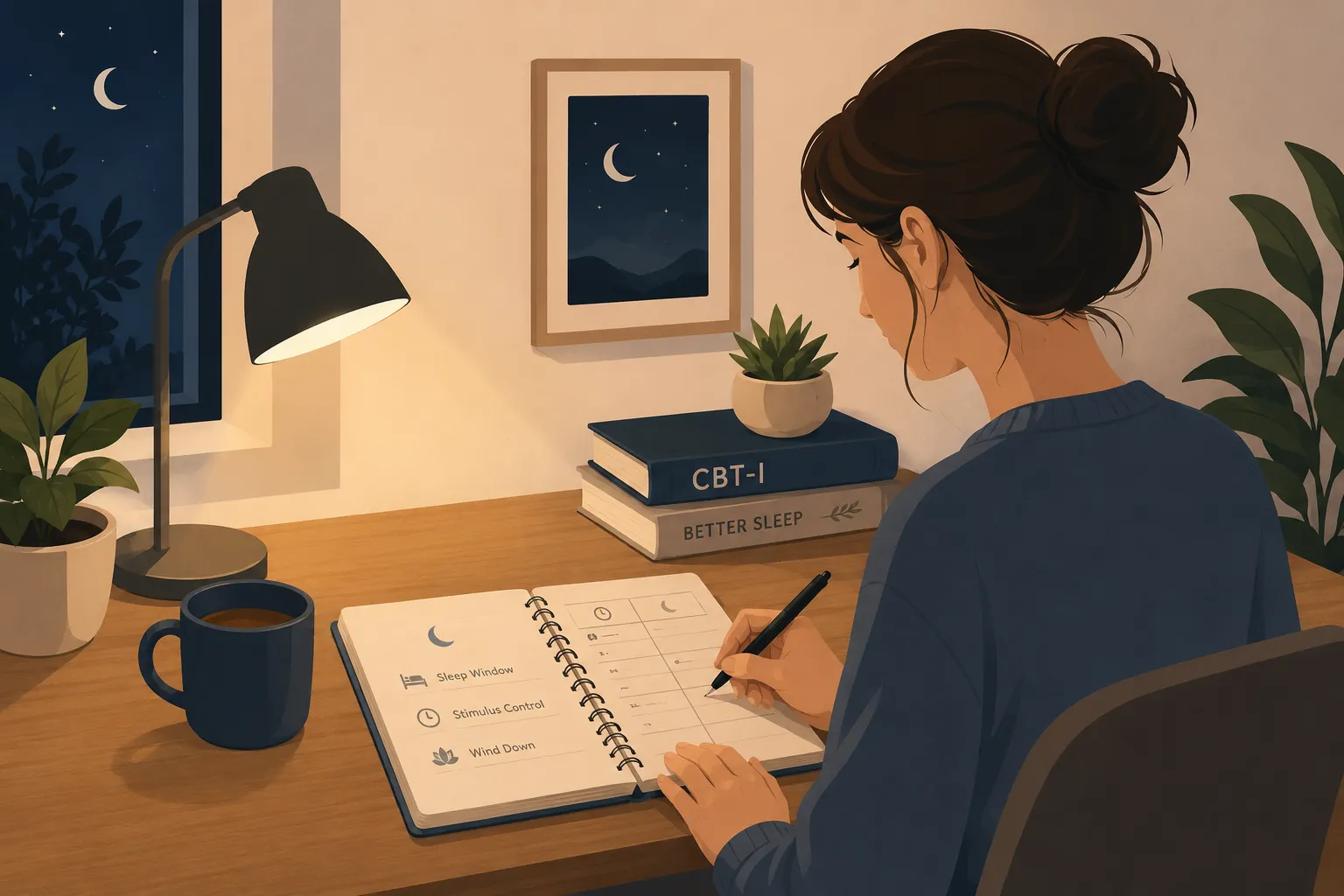
Before you change anything, track what's actually happening. A sleep diary captures: time you got into bed, estimated time to fall asleep, number of awakenings, time you woke up, time you got out of bed, and a rough quality rating. Don't use your phone for this — write it down in the morning, from memory, without checking the clock during the night.
Two weeks of data gives you your baseline sleep efficiency (time asleep ÷ time in bed × 100). Anything below 85% is where CBT-I starts making direct improvements.
Step Two: Set Your Sleep Window
Using your diary average, calculate how much sleep you're actually getting. Set a sleep window — a fixed bedtime and wake time — equal to that amount, with a minimum of five hours. This is your starting point for sleep restriction.
Your wake time is fixed. Your bedtime shifts later as efficiency improves. When your sleep efficiency hits 90% or above for five or more nights, expand the window by 15 minutes. Continue until you're sleeping well across a full seven to eight hours.
Tools Worth Using
You don't need to do this entirely alone. Several well-validated digital tools can structure the process:
- CBT-i Coach — developed by the VA and Stanford, free, guides you through all core components with sleep diary tracking built in
- SHUTi — the most clinically studied digital CBT-I program, subscription-based
- Sleep Ninja — lighter and more accessible, good for mild-to-moderate cases
- Say Goodnight to Insomnia by Gregg Jacobs — the book version, structured as a six-week program
For the cognitive restructuring piece specifically, the tools used in CBT-I overlap with general anxiety management techniques. If racing thoughts are a major driver for you, our piece on the 5-4-3-2-1 grounding technique for anxiety covers a complementary tool for interrupting the rumination loop before bed.
What to Expect in the First Two Weeks
Week one is usually the hardest. Sleep restriction means you're actively limiting time in bed while also feeling the effects of accumulated sleep debt. You'll be tired. You may feel irritable. This is expected and temporary.
Most people start noticing meaningful improvement in sleep efficiency by week two. By week four, the improvements tend to consolidate — falling asleep faster, fewer middle-of-the-night wake-ups, and less anxiety about sleep itself.
The research on repeated courses is also promising: for people who don't fully remit after one round, a second course of self-guided CBT-I produces additional gains. It's not a one-shot intervention for everyone, and that's okay.
When Self-Guided Isn't Enough
CBT-I addresses behavioral and cognitive insomnia. It's less suited to insomnia driven by untreated sleep apnea, circadian rhythm disorders (like delayed sleep phase), or significant psychiatric conditions. If you've run a structured program for four to six weeks and seen no movement, a sleep specialist evaluation makes sense.
Similarly, if your insomnia is tightly coupled with anxiety or depression, those two things tend to reinforce each other. Addressing sleep in isolation may not be sufficient. The gut-brain-sleep connection is also worth considering — there's growing evidence that microbiome health affects sleep quality in ways that pure behavioral intervention won't touch. Our piece on the gut-sleep connection goes deeper on this.
Start Small, But Start
CBT-I is not a quick fix, and self-guided versions require honest tracking and some willingness to feel worse before you feel better. What it offers in return is a genuine structural change in how your brain relates to sleep — not a workaround, not a crutch.
The most practical first step: download the CBT-i Coach app tonight and set up your sleep diary. Run it for two weeks before changing anything else. That data alone will tell you more about your sleep than you currently know — and it's the foundation everything else is built on.
Science Note
Try This
FAQ
How long does it take for CBT-I to work?
Most people see meaningful improvement within two to four weeks, with fuller results by six to eight weeks. Week one is typically the hardest because sleep restriction temporarily increases fatigue before sleep efficiency improves. Research shows benefits lasting 12–24 months, which makes the short-term rough patch worth it. Consistency with the protocol — especially the fixed wake time — is the biggest predictor of how quickly things move.
Can I do CBT-I without a therapist?
Yes. Self-guided CBT-I using apps, books, or structured internet programs produces 70–80% improvement rates in clinical studies — results comparable to therapist-led sessions for most people with chronic insomnia. The main difference is accountability and personalization. Tools like the CBT-i Coach app (free, from VA and Stanford) and the book Say Goodnight to Insomnia provide enough structure to run the program effectively on your own.
What is sleep restriction therapy and is it safe?
Sleep restriction is a CBT-I technique where you limit the time in bed to match how much you're actually sleeping — often five to six hours to start. It builds genuine homeostatic sleep pressure so falling asleep becomes easier. It's safe for most people, though those with bipolar disorder or seizure risk should consult a doctor first, as sleep deprivation can be a trigger. The restriction is temporary and gradually expanded as efficiency improves.
What's the difference between CBT-I and regular CBT?
Regular CBT focuses on changing unhelpful thoughts and behaviors across a wide range of problems. CBT-I applies the same core framework — cognitive restructuring, behavioral change — but specifically to insomnia. It adds sleep-specific tools like sleep restriction, stimulus control (keeping the bed only for sleep), and sleep diaries that regular CBT doesn't include. CBT-I is a specialized protocol, not just general therapy applied to sleep.
Will CBT-I work if I have anxiety or depression too?
Often yes — and treating insomnia with CBT-I frequently improves anxiety and depression symptoms as a secondary benefit. Studies show people who complete CBT-I report lower anxiety and mood disturbances even when those weren't the primary focus. That said, if anxiety or depression is severe, treating sleep alone may not be sufficient. CBT-I works best in combination with addressing the underlying condition, not as a replacement for it.
What are the best apps or tools for self-guided CBT-I?
CBT-i Coach (free, VA and Stanford-developed) is the most accessible starting point — it includes sleep diary tracking, guided techniques, and all five core CBT-I components. SHUTi is the most rigorously studied digital program and shows strong results in clinical trials, though it's subscription-based. Sleep Ninja is a lighter option good for mild cases. For a book-based approach, Say Goodnight to Insomnia by Gregg Jacobs structures the full program across six weeks.
Is CBT-I better than sleeping pills?
For long-term outcomes, yes — consistently. Sleep medications work by sedating you, which addresses the symptom without changing the underlying drivers of insomnia. CBT-I changes the behaviors and thought patterns that maintain insomnia. Head-to-head trials show CBT-I produces superior results at follow-up, with far lower relapse rates. Medications can be appropriate short-term tools, but they're not a standalone solution for chronic insomnia the way CBT-I can be.
Biohacking without the $10K budget
Get practical weekly insights on sleep, gut health, and mindset, built for real life in Southeast Asia and beyond.
Subscribe freeRelated Articles
Sleep & Cortisol: How They Control Your Anxiety Baseline
Your anxiety level isn't just about your thoughts. It's about your cortisol rhythms, your sleep depth, and whether your nervous system ever gets to fully downshift.
Tired But Can't Sleep? Here's What's Actually Wrong
You're running on empty all day, but the second you lie down, your brain switches on. This isn't a willpower problem — it's a nervous system problem.